
HEALTH JOURNAL
Low AMH and Ovarian Reserve: What the Number Can Tell You
Ben Wong · · Updated
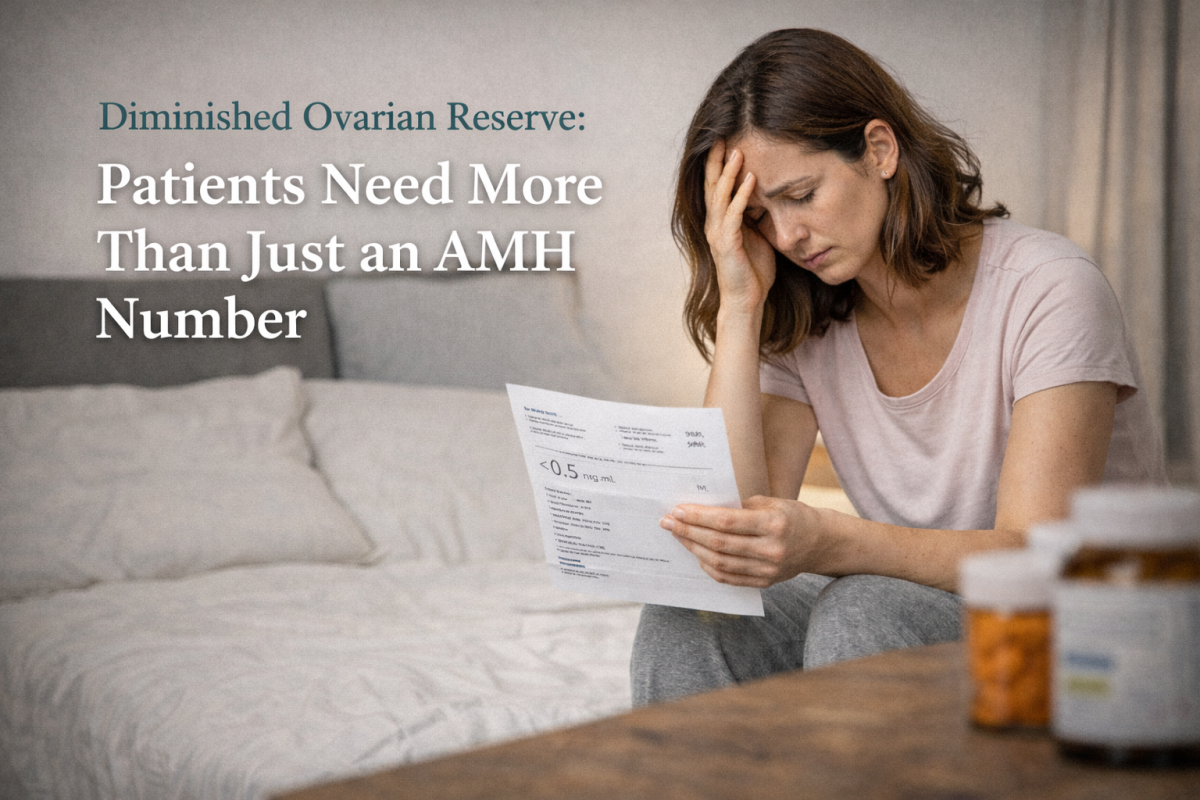
A low AMH result does not by itself determine your chance of a natural pregnancy. Ovarian reserve tests help inform parts of fertility care, especially expected ovarian response, but age, history and the reproductive plan still matter. Acupuncture or herbs should not be promised to restore an egg supply.
Many patients become anxious not because their body suddenly feels dramatically different, but because a blood test gives them a number they did not want to see. Sometimes they were only trying to “check where things stand,” and then AMH comes back low. From that point on, the mind starts racing. Some feel that there is no hope left. Others begin searching for every possible way to “reverse ovarian age.” Some say they will just watch and wait, but underneath that calm, they are already scared.
The real issue with diminished ovarian reserve goes beyond just the quantity of eggs; it also involves the implications of that number for timing and decision-making. When facing diminished ovarian reserve, the challenge is not solely a reduced egg count. It can also lead to changes in reproductive timing and planning. In a Traditional Chinese Medicine (TCM) clinic, the focus often shifts to enhancing sleep, managing stress, promoting recovery, and facilitating clearer fertility planning.
What does diminished ovarian reserve actually mean?
In simple terms, it refers to reduced ovarian reserve in relation to egg quantity. ASRM describes ovarian reserve as reproductive potential related to the number of available oocytes, and diminished ovarian reserve usually refers to a lower-than-expected response or lower reserve relative to age expectations.
The key point for patients is this:
“Lower reserve” does not mean “pregnancy is impossible.”
But it also does not mean “there is no reason to think seriously about time.”
A more useful interpretation is that the reproductive window may be changing, and that planning may need to become clearer.
Why does everyone focus so much on AMH?
Because AMH is convenient, it does reflect part of ovarian reserve. ACOG states that AMH levels at a given time can reflect ovarian reserve.
But the problem is that many patients start treating AMH like a final verdict. It is not.
ASRM’s committee opinion explains that ovarian reserve tests are useful for predicting ovarian response in IVF, but they are poor standalone predictors of natural fertility in women without known infertility, and they should not replace counseling based on age and diagnosis.
In other words, AMH matters, but it is not the whole story.
The more useful questions are:
- How old are you now?
- Is your cycle changing?
- Is bleeding getting lighter?
- Is recovery slower?
- Is there a history of ovarian surgery, endometriosis, chemotherapy, or autoimmune factors?
- Are you trying naturally, seeking evaluation, or already considering IUI / IVF?
- How sensitive is time in your current situation?
That combination is usually much more helpful than a single number.
Why is age still the biggest background factor?
Patients do not always want to hear about age, but clinically, it remains one of the most important parts of the discussion. ASRM’s committee opinion on infertility evaluation states clearly that female age is the single most important predictor of fecundity, and ovarian reserve tests should add to—not replace—counseling based on age and diagnosis.
That does not mean there is a sudden cliff. It means that the same AMH value can mean different things in different people, depending on age, cycle changes, history, and plans.
What do patients usually feel?
Some feel nothing at all and discover the issue only through testing. But others slowly begin to notice:
- lighter bleeding than before
- shorter or less predictable cycles
- slower recovery after the period
- more fatigue
- more anxiety about time
- a sense that the body is less resilient than it used to be
These symptoms do not define the diagnosis on their own, but they are very common. Many patients do not come in solely to ask about AMH. They come in saying that their rhythm, recovery, and confidence no longer feel the same.
How might TCM understand this stage?
TCM usually does not look at this as “one low number.” It often understands the pattern as one involving reserve, rhythm, and recovery changing together.
Common patterns may include weaker Kidney essence or Kidney Qi, reduced Yin or Blood, or diminished recovery capacity. In practical patient language, this often means:
- cycles changing
- lighter flow
- poorer sleep
- more fatigue
- less resilience
- greater anxiety about time
The point is not to rename a lab result in a mystical way. It is to understand why the patient’s body and emotional state are becoming more strained at the same time.
Where may acupuncture and herbs fit?
This is where boundaries matter.
The more accurate statement is not “TCM can reverse AMH,” and not “you just need to tonify the kidneys.” ASRM and ACOG do not support using ovarian reserve markers as simplistic reversible targets, and they do not support interpreting them apart from age and context.
In this setting, acupuncture and herbal medicine may fit best in a few realistic ways:
First, helping the body settle.
Many patients sleep worse, feel more tense, and become more emotionally reactive once they see a low result. Supporting sleep, stress response, and body regulation matters.
Second, helping the cycle rhythm and recovery become easier to observe.
Some patients still menstruate and are not in complete disorder, but their rhythm is becoming less clear. TCM support may help the body feel less chaotic and depleted.
Third, supporting patients through a time-sensitive phase without creating more delay.
For diminished ovarian reserve, the best place for integrative support is not inside an endless “I’ll keep regulating and wait” loop. It is in helping the patient feel steadier while making clearer decisions.
Who may benefit from a structured integrative review?
Patients may benefit from a structured review if they have:
- low AMH plus increasing anxiety
- lighter periods
- shorter, more irregular, or less predictable cycles
- slower recovery
- worse sleep
- a sense that time is becoming more sensitive
- Prior test results that still do not tell them what to do next
What these patients usually need is not a miracle promise. They need a clearer plan.
Diminished ovarian reserve tends to push patients toward two extremes: panic or magical thinking. Neither one helps much.
What helps more is a more honest set of questions:
Where am I now?
How sensitive is time in my situation?
What are the most worthwhile next steps over the next few months?
If this is no longer just about one lab value, but about a changing rhythm, reduced recovery, and growing urgency, then it may be time to stop staring at the number and start organizing the whole picture.
FAQ
Q: Does a low AMH mean I cannot get pregnant?
No. AMH reflects one aspect of ovarian reserve, but it does not, by itself, determine whether pregnancy can still occur naturally. Age, cycle changes, history, and plans all matter too.
Q: Can AMH accurately predict natural pregnancy chances?
It should not be treated as a precise prediction tool. ASRM states that ovarian reserve markers are poor standalone predictors of natural fertility and should not replace age- and diagnosis-based counseling.
Q: Can I just “improve” or “reverse” AMH if I regulate my body?
A more accurate approach is not to chase the number itself. The more important questions are how time-sensitive your situation is, how your cycle is changing, and what choices are most worthwhile now.
Q: What can acupuncture and TCM realistically do here?
They may help support sleep, stress, recovery, menstrual experience, and overall body rhythm so that the patient feels steadier during a time-sensitive phase.
Q: Who may benefit from an integrative review sooner rather than later?
Patients whose reserve markers are low and who are also noticing cycle changes, reduced recovery, poor sleep, fatigue, or increased urgency often benefit from stepping back to look at the whole situation more clearly.
If you are dealing with low AMH, changing cycles, slower recovery, worse sleep, or a growing sense that time matters more now than it did before, an acupuncture consultation for menstrual or fertility-related concerns may help you see the situation more clearly. The goal is not to chase one number. It is to understand timing, body state, and what kind of support makes sense next.
Questions to take to the fertility team
- What does this test mean for my age and current plan?
- Are the result and any other tests consistent, and would repeating it change management?
- How does the result affect the timing of evaluation or treatment?
- What are the relevant options for both partners?
A clear role for a supportive visit
Bring your results and the reproductive clinician’s plan to any acupuncture or herbal consultation. Sleep or pain goals should be discussed separately from egg number, embryo quality and live birth. A change in AMH alone does not establish that a complementary treatment improved fertility.
Practical questions before booking
Should I postpone indicated fertility treatment while trying to raise AMH?
Do not delay the reproductive plan solely on a claim that complementary care can reverse reserve. Discuss timing with the fertility team.